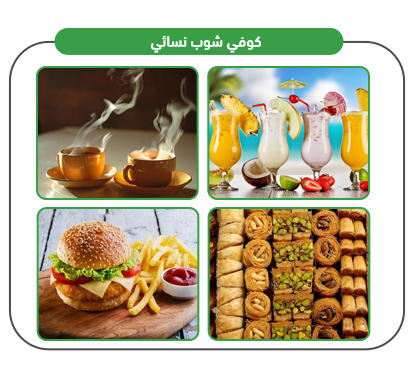
A women’s café offering the finest hot and cold drinks and desserts, as well as training courses, guest speakers, and massage sessions in cooperation with specialized centers.
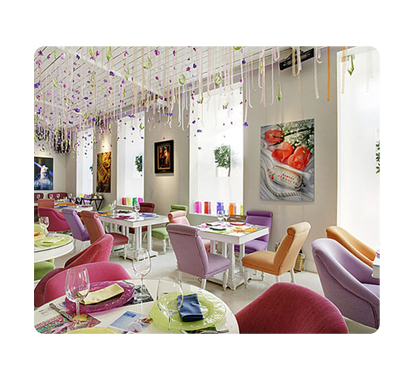
A women’s café serving the finest hot and cold beverages and desserts. It also offers training courses, guest speakers, and massage sessions in cooperation with specialized centers. All necessary facilities are provided, including a location, furniture, and specialized staff, making it suitable for university students, women working in companies, and residents. It has become necessary to provide these services near workplaces and women’s gatherings. This has created a need for cafés in areas with large population centers. The café will contribute significantly to providing entertainment facilities for all women. The café offers all types of beverages in modern ways and at prices that suit the general level of the targeted customers in the area. Café projects are considered cost-effective, but their returns are also considered high.

The middle class (students, university graduates and professors, company managers and employees, doctors, etc.) are those who desire a beverage and primarily visit coffee shops for drinks or to make deals.
The main customers are those who frequent coffee shops.
The upper class customers: These are the financially able group and are less concerned about price than with the quality of service and good treatment.
The other customers are the so-called “flying customers.” These customers should be approached with a policy that attempts to attract them back to the coffee shop by providing them with the best service.
Executive summary
Study project services/products
Market Size Analysis
Risk Assessment
Technical study
Financial study
Organizational and administrative study

Service sector in GCC countries
According to the macroeconomic theory of sectors, the economy is divided into three main and large sectors: the first; – is the sector that is based on collecting raw materials and includes mining companies, timber companies, oil exploration companies, in addition to agricultural and fishing industries. The second sector; is the sector that depends on goods and their sale, such as: (car manufacturing, furniture, clothing trade… etc.). As for the third sector, known as the “services” sector; it is the sector responsible for providing and producing services, essentially relying on intangible things, such as: entertainment, health care, transportation, hospitality, restaurants, etc. This theory believes that the more advanced countries are, the more their economies are based on the third sector, unlike primitive countries, which rely mostly on the first sector (the United States of America, for example, the service sector constitutes 85% of its economy).
Kingdom of Saudi Arabia:
The State of Qatar:
Kuwait:
United Arab Emirates:
Sultanate of Oman:
Global Service Sector
The service sector is the major contributor to the world’s gross product; It alone accounts for more than three fifths of this output. The sector does not rely on the production of tangible goods such as automobile and furniture, but rather on the provision of intangible services such as banking, medical care, transportation, hospitality, leisure, etc. The value of the sector market was estimated in 2020 at USD 10,814.49 billion and rose to USD 11,780.11 billion in 2021. The market achieved a CAGR of 8.9%. After recovering from the effects of the coronavirus pandemic, global market experts expect the sector’s market to reach US $ 15683.84 billion by 2025, bringing the market to a CAGR of 7% in the coming years.