Project: The project involves establishing a vegetable farm using hydroponic farming, where vegetables are grown without soil (hydroponically) to produce fresh vegetables such as cucumbers and tomatoes, as well as leafy greens like lettuce, parsley, arugula, and other leafy products.

The project involves establishing a vegetable farm using hydroponic farming, where vegetables are grown without soil (hydroponically) to produce fresh vegetables such as cucumbers, tomatoes, and leafy greens like lettuce, parsley, arugula, and other leafy products. Hydroponic farming is considered an integrated cultivation system for plants.
The project targets various sectors, including hotels, restaurants, food supply companies, vegetable markets, hypermarkets, supermarkets, as well as individual consumers. The hydroponic farm aims to achieve self-sufficiency in vegetables by reducing imports. Additionally, it seeks to contribute to meeting part of the growing demand for fresh vegetables by employing the latest hydroponic farming techniques and utilizing the available local resources to produce fresh vegetables.
The demand for fresh vegetable products is characterized by both growth and continuity due to the significant increase in population. Therefore, establishing a farm for producing fresh vegetables is considered an investment opportunity that can generate high economic returns.

Significant savings in irrigation water and fertilizers
Increased production per unit area
Savings in agricultural labor
Faster crop production
Reduced use of agricultural pesticides
Easier pest and disease control
Elimination of the need for organic fertilizers
Ability to produce crops out of their normal seasons
Executive summary
Study project services/products
Market Size Analysis.
Risk Assessment.
Technical Study
Financial Study
Regulatory and Administrative Study
Saudi Arabia has given the agricultural sector significant importance over the past five years, especially following the launch of Vision 2030, through which the Kingdom aims to capitalize on available opportunities and resources and achieve a strong, sustainable economy. As a result of its continuous efforts, we have witnessed an expansion of agricultural lands, an increase in crop production, and growth in livestock numbers and fish quantities, contributing to enhancing food security and meeting citizens’ food needs.
Because “Mashroo3k” Economic Consulting and Market Research values keeping its clients informed about key indicators in this vital sector, it has chosen to present here some data that can serve as a guide for those wishing to invest under its umbrella:
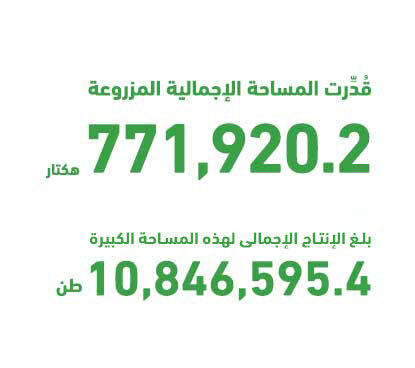
In Saudi Arabia, the total cultivated area of fruits, grains, vegetables (both protected and open-field), in addition to fodder, is estimated at approximately 771,920.2 hectares, with a total production of 10,846,595.4 tons.
The area cultivated with fruits is estimated at 207,369.8 hectares, producing 2,342,150.2 tons.
The area cultivated with grains such as wheat, barley, and others expanded to 262,622.9 hectares, yielding 1,254,966.6 tons.
The area of open-field vegetables reached 88,644.2 hectares, with production totaling 2,111,028.5 tons.
The area cultivated with fodder crops, such as alfalfa and blue panic grass, is estimated at 207,387.9 hectares, producing 4,556,663.5 tons.
The total production capacity of wheat flour in the Kingdom is 15,150 tons/day, while the total operational capacity of wheat silos in Saudi milling companies equals 745,000 tons.
The total production capacity for animal feed in the Kingdom is 3,200 tons/day.
Total manufactured flour amounted to 2,650,111 tons in 2020.
Total manufactured animal feed reached 555,858 tons in 2020.
Mashroo3k considers that investing in the cultivation of onions, pomegranates, bananas, and citrus fruits can be highly profitable within the Kingdom of Saudi Arabia.
Mashroo3k also emphasizes the importance of organic farming as an unmissable opportunity in the Kingdom. The following are its key indicators:
The area dedicated to organic farming in the Kingdom expanded from 13,078 hectares in 2016 to 26,632.49 hectares in 2020. Production in this sector also grew, exceeding 98,558.81 tons in 2020, compared to 56,261 tons in 2016.
In 2019, the area of protected vegetable cultivation reached 2,320 hectares, with an estimated production of 174,207 tons. However, by 2020, this area expanded to 5,895 hectares, and production increased to 584,080 tons (organic farming).
Production of table eggs in organic farming projects rose from 7,000 eggs in 2017 to 454,000 eggs in 2020.
In organic farming projects, honey production reached 22,700 kg, from a total of 6,003 beehives.
Production of milk and dairy products in organic farming projects reached 390 tons.
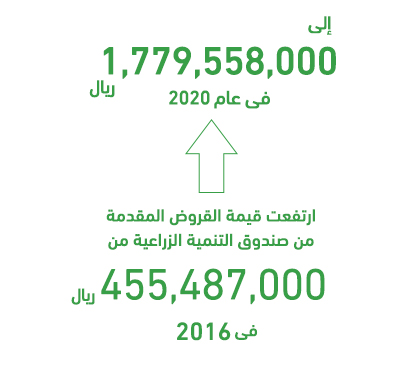
The value of loans provided by the Agricultural Development Fund increased to SAR 1,779,558,000 in 2020, compared to SAR 455,487,000 in 2016.